
• Mission & Community
  • Contact
  • Register

Suzuki Music Academy of Hong Kong

"Music Exists for the purpose of growing an admirable heart" ~Shinichi Suzuki

"Music exists for the purpose of growing an admirable heart"
Shinichi Suzuki
  • Home
  • About SMAHK
  • What is Suzuki?
    • History of the Suzuki Method
    • About the Suzuki Method
  • Programs
    • Instrumental Program
    • Rising Stars Program
    • Little Stars Early Childhood Music
    • Yo Yo Ma Program
    • Faculty
  • Events
    • Calendar
      • Download Calendar
    • Events sign up
      • Graduation Concert
      • Bach in the Subway
      • Prospective Family Parent Seminar
      • T-Shirt Orders
  • News
  • Gallery
    • Photo Gallery
    • Video Gallery
  • Video Gallery
  • T-Shirt Orders
  • School Calendar Download
  • Conference Photos
  • Studio Recitals
  • Photo Gallery
  • Register
  • Contact
  • Faculty
  • About Suzuki Music Academy of Hong Kong

Suzuki in the Dolomites: Andrew and Isabel went in 2016…you could join MS. ALLISON there in 2017!

February 27, 2017 By Diane Slone

Dolomite Suzuki summer music camp 2016

by Andrew, Isabel Zeng and family
On top of all the good things a Suzuki program offers, our favourite is we can combine travel with learning as a family at many camps our Suzuki community offers, so when Ms Diane told us about the new Dolomite camp in early 2016, we immediately were drawn to the idea of learning music at a beautiful location surrounded by history and nature! After all, man is a product of his environment.
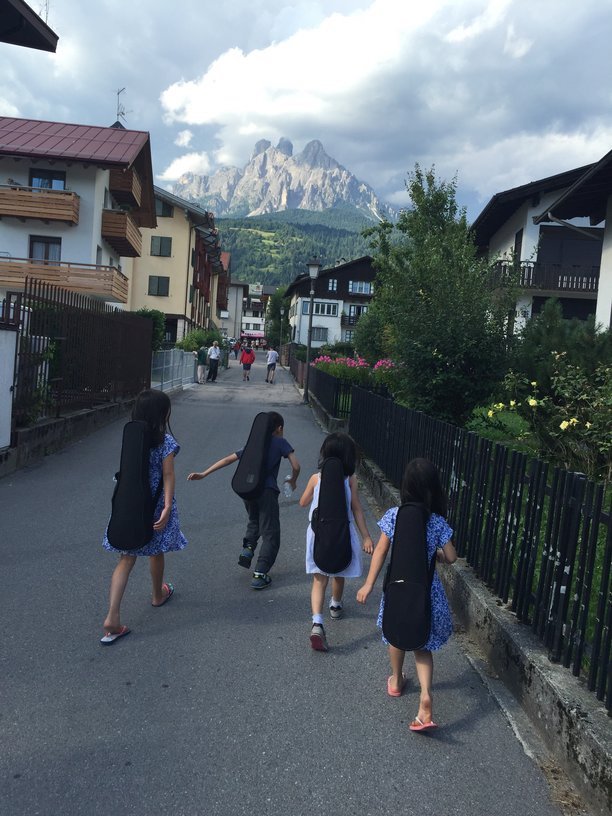
 
Packed with violins and mountain hiking outfits, after 13 hours of flight and 4 hours of driving, we finally arrived at Fiera di Primiero, a small peaceful town at the base of mount Dolomites and so thankful we made the effort to come all the way!
Our camp was conveniently located within 5 minutes walk from the hotel, everyday we would cross a wooden bridge overseeing crystal clear stream with the Dolomite mountains at the backdrop to begin the day. The two week camp consisted of morning and afternoon classes. The mornings started with a group singing lesson, we had the opportunity of a three day music garden program lead by Marco Messina, he taught many interesting new songs and new lyrics of some Suzuki book 1 songs.
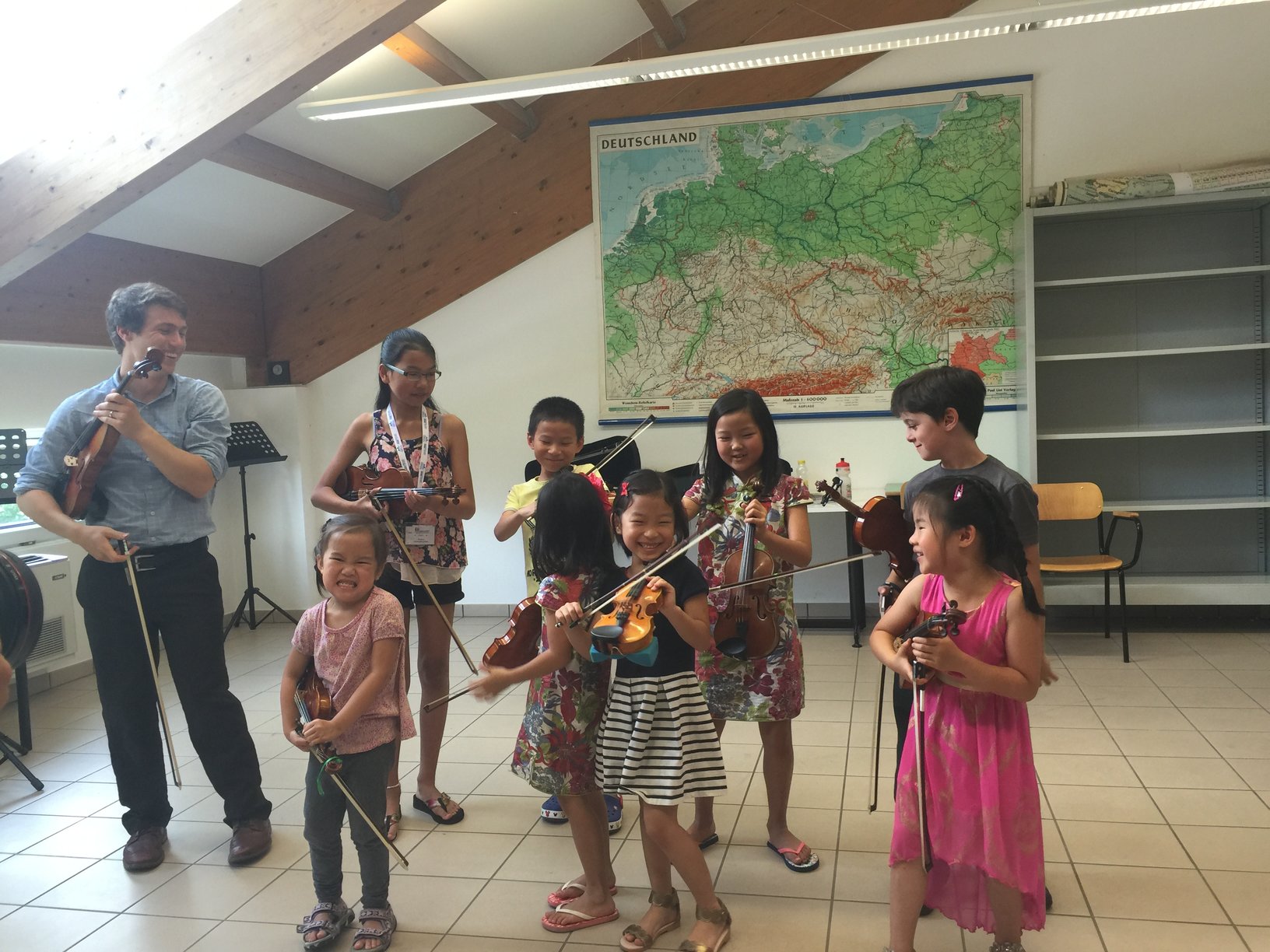
We then took a break and had a group instrument lesson. After lunch, we continued with private instrumental lessons where all students could observe and ended the day early with an orchestra practice to leave some time for leisure. Whilst the course was much more intense, the atmosphere of the camp was relaxed, when time permitted we went to observe other classes, learning more about the Suzuki program and the violin. One lesson I remembered vividly was how one had to overcome shyness to open up in front of strangers when performing. The camp was completed with a formal concert where each student performed a solo piece for the local residents. Being in Italy, the birth place of Paganini, Vivaldi and the like, you could hear in the applause how much the audiences appreciated classical music. The youngest violin group class also had an opportunity to perform on the street.
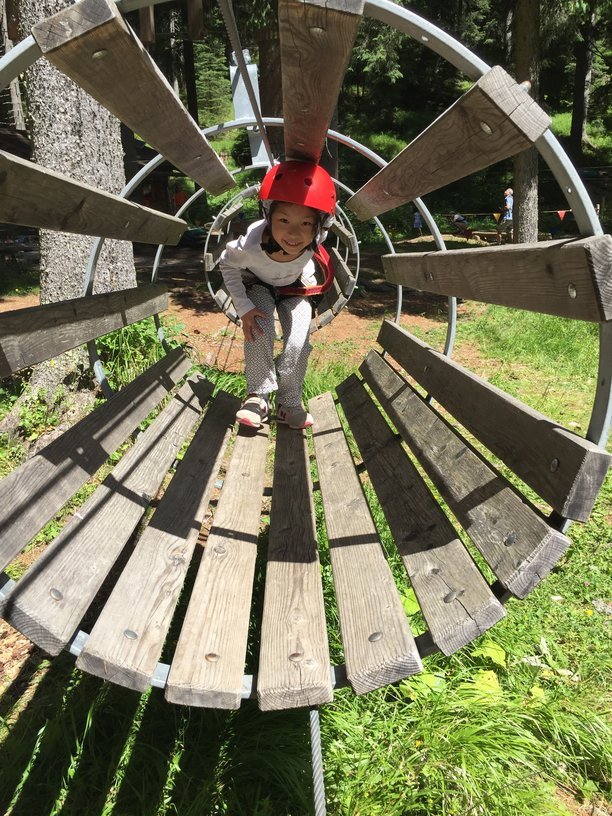
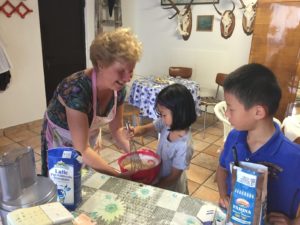
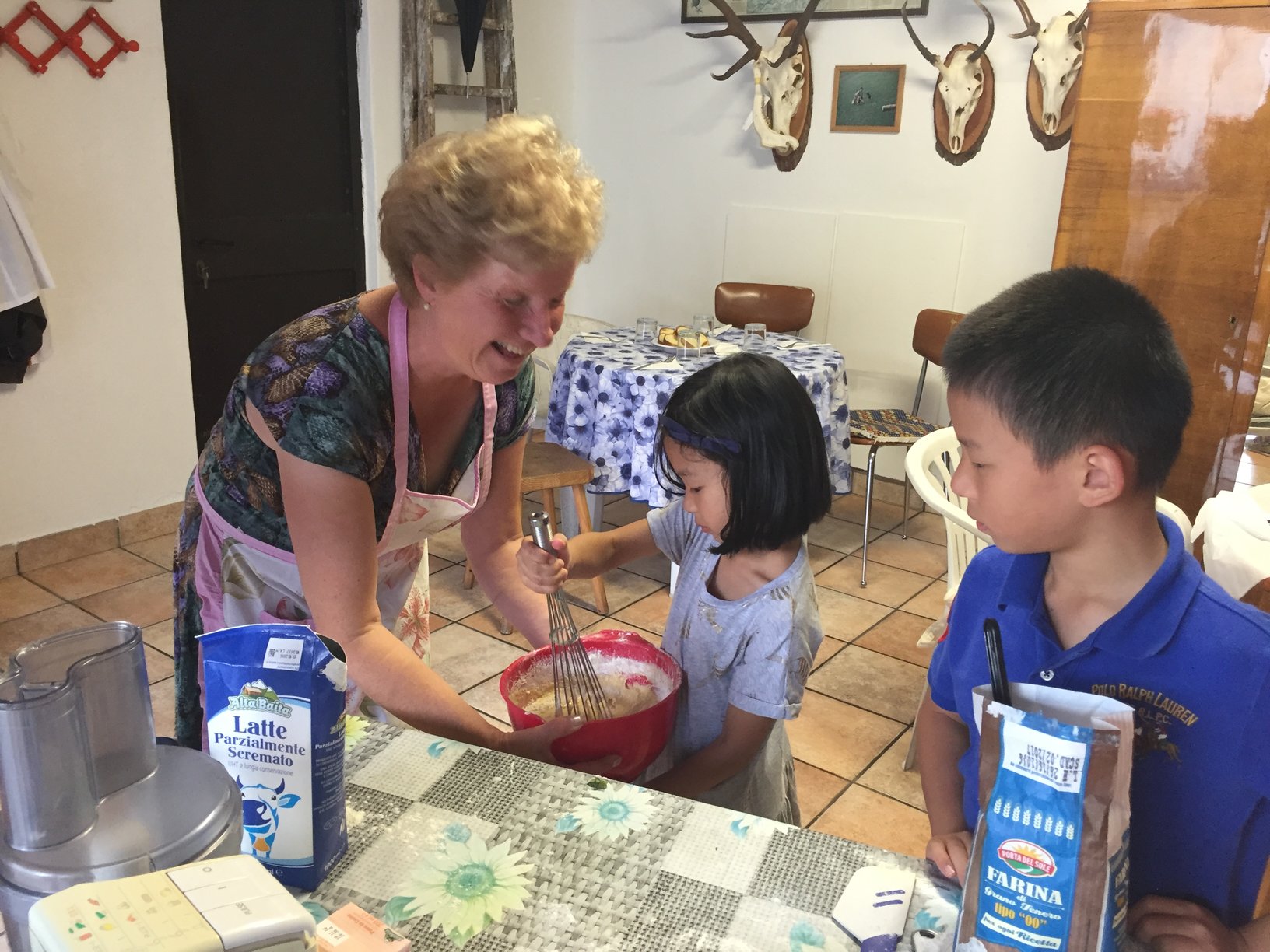
Lunch was served at the canteen on campus, and with parks nearby, the kids spent their breaks hanging out with new friends whilst parents sat back and exchanged ideas. The camp organiser was kind enough to offer extra activities such as hiking, cooking class and a day trip to Venice.
The only side effect of having to study there was the temptation of alluring sights of Mt Dolomites appearing in every corner of the campus, so when the weekend finally arrived, we put on hiking shoes and marched out to embrace the nature. Passing wildflower meadows beneath a blue sky, listening to the cow bell ringing at the background, breathing in the most precious fresh mountain air and watching the magical Dolomite mountains change into pink and red hue at dusk. The violin forest where the Stradivarius violin wood was said to come from, the turquoise water lake, the museum of Otzi of a 5000 years old iceman, the adventure park await you, not to mention the window shopping in Venice and being completely museumed out in Florence! Please do allow some extra time if you can to truly appreciate what Dolomites and Italy has to offer…

Alice’s Night with Iskandar (and Dad)

January 23, 2017 By Diane Slone

by Ming and Alice Wan

Once a violinist said “there is no right age limit. Some kids can sit still in a concert for a couple hours at age 6, some have to wait until age 13. Every child is different so don’t try to force the issues. You will know when your child is ready.”

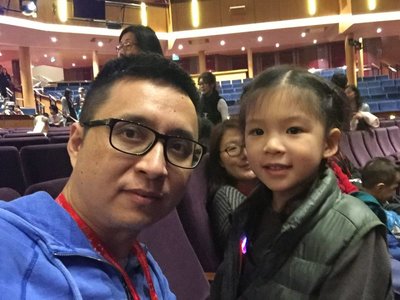
Last November Alice and I went to a young violinist Iskandar Widjaja’s Hong Kong recital debut.  This concert was recommended by Ms. Diane.

It was not the first time Alice and I went to concert. But still I was concerned about whether Alice can sit through the whole recital given it is a 100-minute concert.  C. Franck, Bach, Handel, Schuman, will she really understand all those?

We arrived in City Hall twenty minutes earlier. So, Alice had enough time to get ready, and I can remind her to keep quiet during the performance. I had been promoting that Iskandar was once a Suzuki student, which got Alice excited.

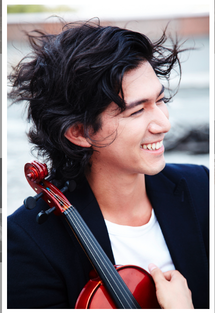
Iskandar was young, energetic and handsome, and his varied techniques on sonic nuances and facets were impressive. Alice concentrated on the violinist’s performance and seemed much enjoyed. The second piece was C. Franck’s Sonata in A major, 28 minutes long. That raised some challenges to Alice and she started to move around in her chair. Then I had to place my hand on her shoulder to remind her.

Alice and I left the concert a bit earlier than its ending. Alice told me two things: first, she thought the violinist’s dress looked funny, and secondly, she wanted to become a violinist just like Iskandar. When I asked Alice if she enjoyed the concert, she gave me a firm “yes”.

Bringing kids to concert is challenging as it is usually hard for our kids to sit through a concert. However, sharing beautiful classic music is one of the greatest gifts a parent can give their child and each concert can encourage children’s imagination and creativity. I’m glad that I brought Alice to the concert and will continue doing so.

Last, FYI, the American violinist Rachel Barton Pine will perform in the coming June in HK.  Rachel was a Suzuki student and once taught by Ms. Diane at a summer camp.  This time she is going to play two pieces from the Suzuki repertoire!

Parents as Partners Online Returns!

January 13, 2017 By Diane Slone

Screen Shot 2017-01-13 at 9.49.25 AM


We are thrilled to announce that the Suzuki Association of the Americas’ Parents as Partners Online virtual conference will return beginning 25 January, 2017.   It has been so successful that they’ve extended the dates of the conference by four months!   This year, once released, videos will be available until October rather than just to June.

Parents as Partners Online conference offers video inspiration and support.  Although it’s marketed for parents, it is very useful for teachers as well.   Our KSMA teachers view and discuss one video at every weekly staff meeting, which gives each of us more tools for our teaching toolbox.

Parents who have participated in the conference in the past have found it to be very valuable; in fact, we have been receiving emails for the past several months asking about it…finally, today, the SAA has released the information!

If you would like to join, please complete the form below and give your payment to Ms. Lan.

Cost

before 25 January:  HK$90

after 25 January: HK$120


Nicole’s experience with Iskandar Wdjaja

October 27, 2016 By Diane Slone

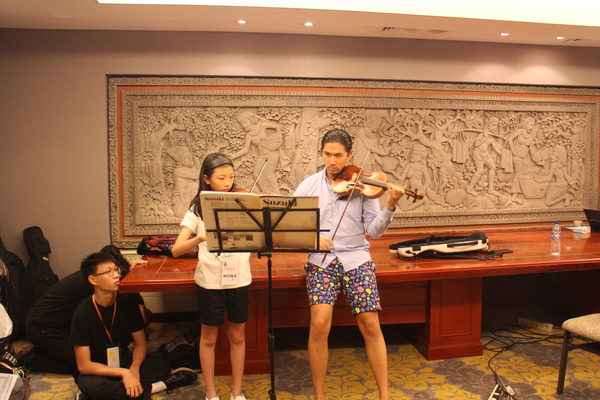
img_8328jpgAt the Suzuki convention this summer in Bali, I had a masterclass with Iskandar Wdjaja. It was a fun experience and I learnt a lot.

The first thing I noticed when I walked into the masterclass was that there were other people too. There were a least a dozen people watching the person playing, so I was pretty nervous. When it was my turn, I played Fiocco Allegro. He gave me some advice and we went through the piece together a few times, with some more tips along the way.

It was definitely an enriching class and I feel a lot more confident playing that piece now. Mr Wdjaja was a good teacher and was very helpful and encouraging.


*****************


Iskandar Wdjaja is giving a recital in Hong Kong!

His program even includes a piece from the Suzuki repertoire…the Handel Sonata No. 4 in D major that’s in Book 6!

Here is the information so that you can take advantage of this amazing opportunity:

http://www.pphk.org/concerts/recitals/iskandar-widjaja/iskandar

Teachers Respond to “Are You Inadvertently Sabotaging Your Child’s Lesson?”

May 11, 2016 By Diane Slone

Screen Shot 2016-05-11 at 12.02.49 PMEach week this term, our faculty and staff  have been watching one video from the Suzuki Association of the Americas “Parents as Partners Online” (PPO) seminar.   After watching, we’ve had time together to discuss the video, and then each of us has taken things from each video and discussion to share with our students and parents in our teaching…sometimes we have goals as a faculty, other weeks the things we take back to our lessons are individual.

The title of this article comes from the title of the video from our most recent meeting.   The video was presented by Teri Einfeldt, former chair of the Suzuki Association of the Americas.  Here are responses to the video that our faculty and staff  would like to share with all of our families. We hope that they give you some “food for thought”, and that you are inspired to join the PPO with us next winter! :


11084285_921682884520641_2388150852829680276_n

After watching Ms. Teri’s video, I will not have comments on using mobile phone in the lesson as I think it is COMMON SENSE and MANNERS to know what should and should not do when the parents are having lesson with their children. If not, it means they do not know how to respect and treasure the time they are with the children.

From the video, I was attracted by the two sentences below:

“Practice makes permanent” AND

“Old pieces equal vegetable, new pieces equal dessert”

We always think that “Practice makes perfect”, Ms. Teri let me know it is not “perfect” but “permanent” today. It is true, keep practicing may not make you to play the song perfectly, however, it does help to build a strength foundation, going further in the journey of music.

Suzuki method emphasizes “Repetition”, however, what I heard some parents mentioned “Why does he/she need to keep playing the old pieces?” OR “Why do we always go back to the old pieces? It is wasting the time”. I believe deep learning of each piece is very important as children can use the techniques that they learnt from the old piece and then apply to the new pieces. Dessert is tasty, however, vegetable is good for health.     ~Lan Yick

img_6931
After watching Teri Einfeldt’s video, I was particularly affected by what she had to say about what happens before, during, and after the lesson.  So many things can affect the lesson!  It is important to prepare yourself and your child for the lesson physically and mentally.  For example, if you are in a rush to get to the lesson, your child may not feel relaxed when you finally arrive.  In addition, they might feel frantic or unsettled because they didn’t have time to think before the lesson began.  If you arrive early, have time to sit and prepare yourselves for the lesson, it is more likely to have a good start!

During the lesson, it is important to be present and be supportive.  Using your phone for note-taking and videos is great!  Texting and emailing is not–like Teri pointed out, your child is aware, and can feel like whomever you are texting is more important to you than he/she is in that moment.

I thought of Dr. Suzuki’s words, “Ability is knowledge plus 10,000 times”  Ten thousand is A LOT!  If we work on our review pieces every week, over a series of years, we will absolutely reach 10,000.  If you’ve had an assignment for one week, the likelihood that your child has reached 10,000 repetitions is not realistic.  Rome wasn’t built in a day.

We all want what is best for our children, and often don’t realize how a small change or small issue in an adult mind can be a big issue in a child’s mind.  Let’s work together to notice and appreciate achievements, and remember that practice makes permanent.      ~Monica Johnston

OLYMPUS DIGITAL CAMERA


“When the parent uses his/her phone in the lesson and the child sees it, the child will think that whatever in the phone is more important than his/her lesson.”

I think that is true. As we are living in a world that allow people to communicate faster, a lot of time instant replying is needed. As an adult, we need to train ourselves to wait til after the lesson to reply rather than during the lesson.

“Practice make permanent”

Yes, “practice make perfect”, if you practice the right way, but “practice make permanent” if you practice the wrong way.     ~Jason Kai

img_7824

I like how Ms. Teri talked about no talking in class. If parents do not make a comment during lessons, students often performs better. BUT sometimes we do need to give credits to the parents because they are trying very hard to become Suzuki parents. ~Rebekah Lau

I want the parents to know that the children are very aware of the parents’ body language and facial cues when they are in the lesson. Parents hope their children to stand up in private lesson and perform and learn at their best. Because of this expectation, it can be hard to suppress the rolling of the eyes, clicking the tongue, or calling out the student’s name in an irritated manner when the student does something the way it was not practiced at home. We as teachers are familiar with this phenomenon with the student — it often means that the skill hasn’t solidified yet enough to be consistent. As a parent you are clearly the most important person in the room to the student, and your feedback matters to them no matter what circumstance they are in. If you can hold back the impulse to show disapproval at moments like this, you may be saving the student’s focus for the rest of the lesson!img_6937

Also, students need to be okay with the process of going from the unknown to the known when acquiring a new skill, and we as adults need to acknowledge that ‘misfiring’ is simply a part of the learning process, that learning takes time, and that it is alright to struggle on the way.

I also want to point out that it’s unfair to expect the best outcome (or any outcome) in a lesson when the students have not had enough preparation at home to feel confident with themselves– whether it means sufficient time, quality, or the kind of practice needed for a particular skill. No one likes to be caught unprepared. Often times it’s not the content of the lesson or the demeanor of the teacher that makes it a discouraging experience for the student, but the student’s perception of himself in regard to readiness for that lesson that makes it so. Confidence, ease, mastery, and capacity for enjoyment are all based on mindful and caring preparation.      ~Yuko Saito  

“If you look to your phone or do something else to pay attention in class, your child will think that anything is more important than him”.      ~Sandra Lozano (Words of Ms. Teri)

rsz_sandra_graduation_rehearsal
I strongly value the benefits we gain from being able to easily use technology in our lessons.   It’s wonderful when I can have a parent instantly take a video to use in home practice, or a photo for comparison during their daily work at home.   I also have a few parents who I know actively take their lesson notes on their device; though that is not my personal preference, it is something I do occasionally out of need (no paper or pen in sight!).   However, after hearing Teri Einfeldt talk about our children’s response to us having our device in-hand during lessons, I’m rethinking…I have had one student this term where I had to have her mom turn the phone around and prove to her child that she was recording the lesson…the child instantly thought the mom was “playing” on her phone when she noticed the device was out.   Bringing our devices out is a distraction even when we are using them appropriately for the lesson environment.   And, when I think about Teri Einfeldt’s statement that when our children see us on our devices they believe that we value what we’re doing more than we value our children, and especially more than we value that time and experience with them…perhaps our studios need to become completely technology free.   I’ve noticed that the video is also causing me to rethink how and when I use my technology at home…it is hampering my work-at-home intentions, but better for my relationship with my tween.    ~Diane Slone                                                                    rsz_diane_and_jude

« Previous Page
Next Page »

25/F Times Media Centre
133 Wanchai Road
Wanchai, Hong Kong

directions

Suzuki Music Academy of Hong Kong believes:

Follow us on Facebook

Search

  • HOME
  • PROGRAMS
  • EVENTS
  • GALLERY
  • REGISTER

Copyright © 2026 · Magazine Pro Theme On Genesis Framework · WordPress · Log in