 Each week this term, our faculty and staff have been watching one video from the Suzuki Association of the Americas “Parents as Partners Online” (PPO) seminar. After watching, we’ve had time together to discuss the video, and then each of us has taken things from each video and discussion to share with our students and parents in our teaching…sometimes we have goals as a faculty, other weeks the things we take back to our lessons are individual.
The title of this article comes from the title of the video from our most recent meeting. The video was presented by Teri Einfeldt, former chair of the Suzuki Association of the Americas. Here are responses to the video that our faculty and staff would like to share with all of our families. We hope that they give you some “food for thought”, and that you are inspired to join the PPO with us next winter! :
After watching Ms. Teri’s video, I will not have comments on using mobile phone in the lesson as I think it is COMMON SENSE and MANNERS to know what should and should not do when the parents are having lesson with their children. If not, it means they do not know how to respect and treasure the time they are with the children.
From the video, I was attracted by the two sentences below:
“Practice makes permanent” AND
“Old pieces equal vegetable, new pieces equal dessert”
We always think that “Practice makes perfect”, Ms. Teri let me know it is not “perfect” but “permanent” today. It is true, keep practicing may not make you to play the song perfectly, however, it does help to build a strength foundation, going further in the journey of music.
Suzuki method emphasizes “Repetition”, however, what I heard some parents mentioned “Why does he/she need to keep playing the old pieces?” OR “Why do we always go back to the old pieces? It is wasting the time”. I believe deep learning of each piece is very important as children can use the techniques that they learnt from the old piece and then apply to the new pieces. Dessert is tasty, however, vegetable is good for health. ~Lan Yick

After watching Teri Einfeldt’s video, I was particularly affected by what she had to say about what happens before, during, and after the lesson. So many things can affect the lesson! It is important to prepare yourself and your child for the lesson physically and mentally. For example, if you are in a rush to get to the lesson, your child may not feel relaxed when you finally arrive. In addition, they might feel frantic or unsettled because they didn’t have time to think before the lesson began. If you arrive early, have time to sit and prepare yourselves for the lesson, it is more likely to have a good start!
During the lesson, it is important to be present and be supportive. Using your phone for note-taking and videos is great! Texting and emailing is not–like Teri pointed out, your child is aware, and can feel like whomever you are texting is more important to you than he/she is in that moment.
I thought of Dr. Suzuki’s words, “Ability is knowledge plus 10,000 times” Ten thousand is A LOT! If we work on our review pieces every week, over a series of years, we will absolutely reach 10,000. If you’ve had an assignment for one week, the likelihood that your child has reached 10,000 repetitions is not realistic. Rome wasn’t built in a day.
We all want what is best for our children, and often don’t realize how a small change or small issue in an adult mind can be a big issue in a child’s mind. Let’s work together to notice and appreciate achievements, and remember that practice makes permanent. ~Monica Johnston
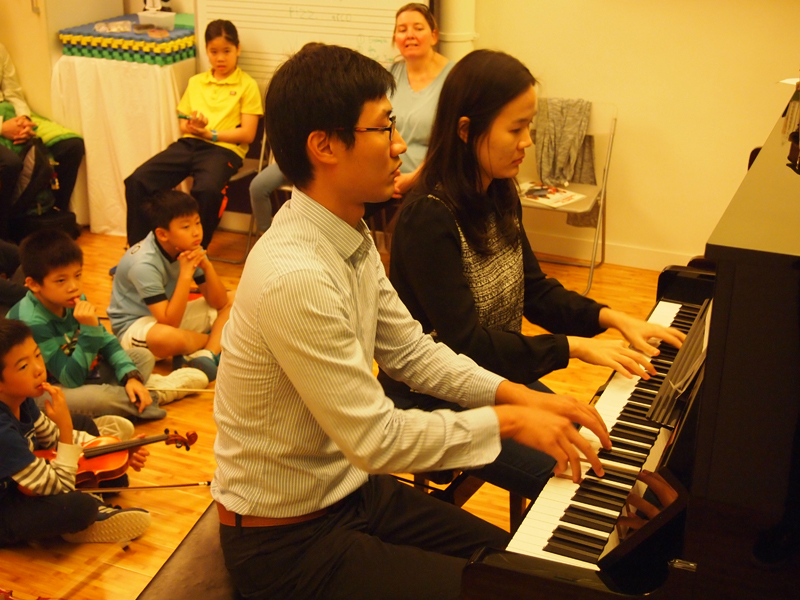
“When the parent uses his/her phone in the lesson and the child sees it, the child will think that whatever in the phone is more important than his/her lesson.”
I think that is true. As we are living in a world that allow people to communicate faster, a lot of time instant replying is needed. As an adult, we need to train ourselves to wait til after the lesson to reply rather than during the lesson.
“Practice make permanent”
Yes, “practice make perfect”, if you practice the right way, but “practice make permanent” if you practice the wrong way. ~Jason Kai
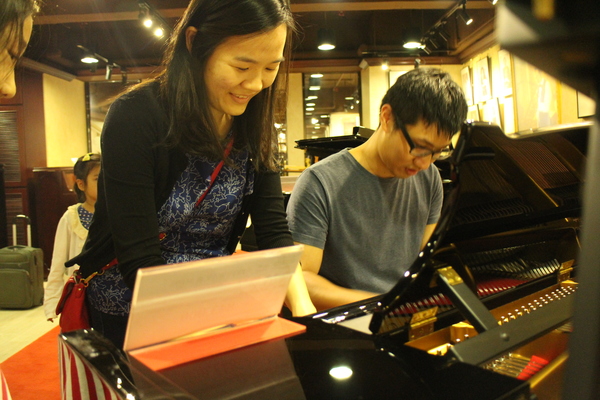
I like how Ms. Teri talked about no talking in class. If parents do not make a comment during lessons, students often performs better. BUT sometimes we do need to give credits to the parents because they are trying very hard to become Suzuki parents. ~Rebekah Lau
I want the parents to know that the children are very aware of the parents’ body language and facial cues when they are in the lesson. Parents hope their children to stand up in private lesson and perform and learn at their best. Because of this expectation, it can be hard to suppress the rolling of the eyes, clicking the tongue, or calling out the student’s name in an irritated manner when the student does something the way it was not practiced at home. We as teachers are familiar with this phenomenon with the student — it often means that the skill hasn’t solidified yet enough to be consistent. As a parent you are clearly the most important person in the room to the student, and your feedback matters to them no matter what circumstance they are in. If you can hold back the impulse to show disapproval at moments like this, you may be saving the student’s focus for the rest of the lesson!
Also, students need to be okay with the process of going from the unknown to the known when acquiring a new skill, and we as adults need to acknowledge that ‘misfiring’ is simply a part of the learning process, that learning takes time, and that it is alright to struggle on the way.
I also want to point out that it’s unfair to expect the best outcome (or any outcome) in a lesson when the students have not had enough preparation at home to feel confident with themselves– whether it means sufficient time, quality, or the kind of practice needed for a particular skill. No one likes to be caught unprepared. Often times it’s not the content of the lesson or the demeanor of the teacher that makes it a discouraging experience for the student, but the student’s perception of himself in regard to readiness for that lesson that makes it so. Confidence, ease, mastery, and capacity for enjoyment are all based on mindful and caring preparation. ~Yuko Saito
“If you look to your phone or do something else to pay attention in class, your child will think that anything is more important than him”. ~Sandra Lozano (Words of Ms. Teri)

I strongly value the benefits we gain from being able to easily use technology in our lessons. It’s wonderful when I can have a parent instantly take a video to use in home practice, or a photo for comparison during their daily work at home. I also have a few parents who I know actively take their lesson notes on their device; though that is not my personal preference, it is something I do occasionally out of need (no paper or pen in sight!). However, after hearing Teri Einfeldt talk about our children’s response to us having our device in-hand during lessons, I’m rethinking…I have had one student this term where I had to have her mom turn the phone around and prove to her child that she was recording the lesson…the child instantly thought the mom was “playing” on her phone when she noticed the device was out. Bringing our devices out is a distraction even when we are using them appropriately for the lesson environment. And, when I think about Teri Einfeldt’s statement that when our children see us on our devices they believe that we value what we’re doing more than we value our children, and especially more than we value that time and experience with them…perhaps our studios need to become completely technology free. I’ve noticed that the video is also causing me to rethink how and when I use my technology at home…it is hampering my work-at-home intentions, but better for my relationship with my tween. ~Diane Slone